
The following is a guest post by Christian Moraga (@cubisteffects). If you are interested in guest posting, please contact me!
After reading Part 1 of the M.I.Y series: Tools and Techniques, you should have a good grasp of what is required to get into your pedal and start modding. But before we flick on the soldering iron, I thought I’d write a few points about the diode, the key component to Part 2 of the M.I.Y series: Diode Clipping.
 A diode is an electronic component that allows electricity to flow in one direction, much like a valve does letting water go one way but not the other. Diodes can be seen in nearly all effect pedal schematics and are noted as this symbol (left). They are integral in creating that overdrive or distortion sounds in your favorite dirt pedals, and come in different packages, materials and sizes. Each diode has a positive side (anode) and negative side (cathode). This polarity is what resembles a valve, and dictates the flow of electricity.
But how does a diode contribute to that overdrive sound? If we look at an audio signal (represented as a sine wave) we can distort the signal by “clipping” the tops and bottoms of the wave. This clipping produces harmonics that we hear as overdrive.
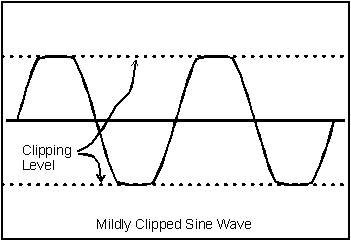
Image source: www.geofex.com
If a signal is clipped evenly on both top and bottom of the wave, this is referred to as symmetrical clipping and is used in pedals such as the Ibanez Tubescreamer. If a signal is clipped more heavily at one peak than the other, this is called asymmetrical clipping as heard in the BOSS SD-1 Overdrive. The more heavily a peak is clipped, the more a sine wave moves closer to a square wave, and closer to distortion and fuzz.
Image source: www.diystompboxes.com
The location of clipping diodes has an effect on the sound as well. Soft clipping involves having two diodes connected on the feedback-path of an opamp or a transistor (Tubescreamer). Hard clipping is when two diodes shunt to ground, creating distortion as in the ProCo RAT. The material of the diode also affects the clipping. Silicon diodes have been described as being “sharper” and “tighter” whereas germanium diodes are described as being more”compressed” or “spongey”. You can also use LEDs (light emitting diodes), Zeners, Schottkys, MOSFETs etc… the experimental possibilities are endless.
So with all of that in mind, let’s crack open a pedal. We will need [1]:
- A pedal (I will be using a BOSS SD-1),
- A selection of diodes,
- Single in-line break away sockets (purchased from any electronics store),
- The schematic of the pedal (that can be found at the resources listed in Part 1 of the series).


Firstly, unscrew the back so we can get to the PCB. You should be able to see a trace side, full of tracks and solder joins [2]. Carefully lift up the PCB so we can see the component side, and look for a set of diodes [3]. The markings (e.g D3, D4, D5) should correspond to your schematic. Desolder these diodes, marking down their original orientation, and clear the holes. Solder in a socket for each hole from where the diode was removed [4] and place the PCB back into the pedal. We can now experiment with different diodes, and combinations of diodes, and immediately hear the difference between them.
Place the diodes (using the same polarity as you marked down earlier) back into the sockets, power up the pedal, plug in and play. No need to close the pedal back up, it will just be a bit noisier. Now remove the power, remove the diodes and try another combination. Power, plug and play – hear the difference. Now try a symmetrical configuration, then asymmetrical.
In the place of one diode, try a MOSFET like an MPF102 (note in [1] how I bent only the ground pin to remove). Or you could try germanium and silicon diode in series, a silicon and LED, two silicons in series, two germaniums in series etc. To solder diodes in series, ensure that the cathode is soldered to the anode [5]. Using diodes in series increases headroom and volume but sacrifices a bit of gain. Use MOSFETs for “tube-like response” and LEDs (reds are great) for crunch and higher gain. When you find a combination you prefer, desolder the sockets and solder in your killer selection. Close the pedal back up and you now have a diode clipping modded pedal. Common mods include placing different diode combinations on switches, or a symmetrical/asymmetrical diode switch. But we may leave that till next time…
Happy modding,
C.
About the author.
Christian Moraga is the owner of CubistEffects.com located in Sydney, Australia. Christian repairs and mods most brands of pedals like BOSS, Ibanez, EHX , Arion, MXR, Danelectro, Marshall, Dunlop, VooDoo Labs, Digitech, DOD etc and specialise in Big Muffs and ProCo Rats. He also makes custom switching and loopers for your pedalboard needs. A/B, True Bypass, Tap Tempo etc.A note from EffectsBay.com
I found Christian while doing some research on the Line 6 DL4, where Christian has some great mods available!
Remember, if you like reading about pedals and seeing videos reviews from others, please subscribe to the RSS feed and get notified via email when there are new postings!

-
16 years ago
Christian.. so based on the Boss SD-1 schematic (http://www.experimentalistsanonymous.com/diy/Schematics/Distortion%20Boost%20and%20Overdrive/BOSS%20SD-1.gif) it looks to be using asymmetrical clipping (double sided)? Is this correct?
If you wanted to convert it to symmetrical clipping would you just ‘jump’ where you’d be missing a diode?
Reply -
16 years ago
Also, how to determine the proper LED values needed? Would you run a multimeter and check the amperage flowing and match the proper rating? What happens if you choke the current before the diode? Will it just be quieter?
Reply -
-
-
16 years ago
Glad you enjoyed the post guys!
Just to answer Hank’s questions…
Yes the SD-1 has asymmetrical clipping. Looking at the schematic linked above, you can see three 1N914 silicon diodes below the 4558 IC. One diode is going one way (D4) while a pair in series is going the other (D5, D6). To make this clipping symmetrical, replace D4 with a pair of 1N914s in series, or remove D5 or D6 and jumper. Both methods will sound different.
As for checking which LED to use, this form of experimentation is fairly safe. You can replace any clipping diode without fear of damage to the circuit, it will just sound different.Every diode has a “clipping threshold” or forward voltage drop – a value that once is exceeded, it will clip the audio signal. Ge diodes have a threshold of around 250mV whereas Si diodes are around 500mV. The higher the threshold, the higher the headroom, volume and dynamics, but lower the gain. Placing diodes in series increases the threshold, thus its efect on the signal. LEDs act in the same manner and have different characteristics with size and colour. Try them all!
C.
Reply
.-= Christian´s last blog ..LINE 6 FM4 FILTER MODELER MODIFICATIONS =-. -
16 years ago
Oh, great. Now i’m all tempted to mod my SD-1… I just might! Here’s to hoping i don’t break it if i do! 🙂 Great post, Christian.
Reply


